Overview
Summarise with AI
Opens the assistant with a summary prompt. Gemini does not accept a prompt in the link, so paste it there.
After storm damage, the sequence that matters is make it safe, document it, then claim. An insurer covers damage rather than age, which is why a roof already near the end of its life frequently receives a partial scope instead of a full replacement, and why that is a normal outcome rather than a refusal. The most useful evidence is photographs of specific damage taken before any temporary repair, since a tarp over a hole removes the proof along with the water. Western Sydney takes the brunt of summer storm cells crossing the plain, and hail on an ageing roof commonly converts a maintenance decision into a replacement one.
Key points
- Make it safe first, then document, then claim
- Photograph the specific damage before covering anything
- Insurance covers damage, not age, so partial scopes are normal
- Western Sydney sits in the path of most summer storm cells
- A roofer's job is to describe what failed, not to argue the claim
- Emergency make-safe work is usually claimable in its own right
The order of operations after a storm
Safety comes before evidence and evidence comes before the claim, and doing them out of order costs people money.
- 1. Make it safe
- Stay off the roof. If water is coming in, contain it from inside and get emergency make-safe work done. That work is usually claimable in its own right, so keep the invoice.
- 2. Photograph before covering
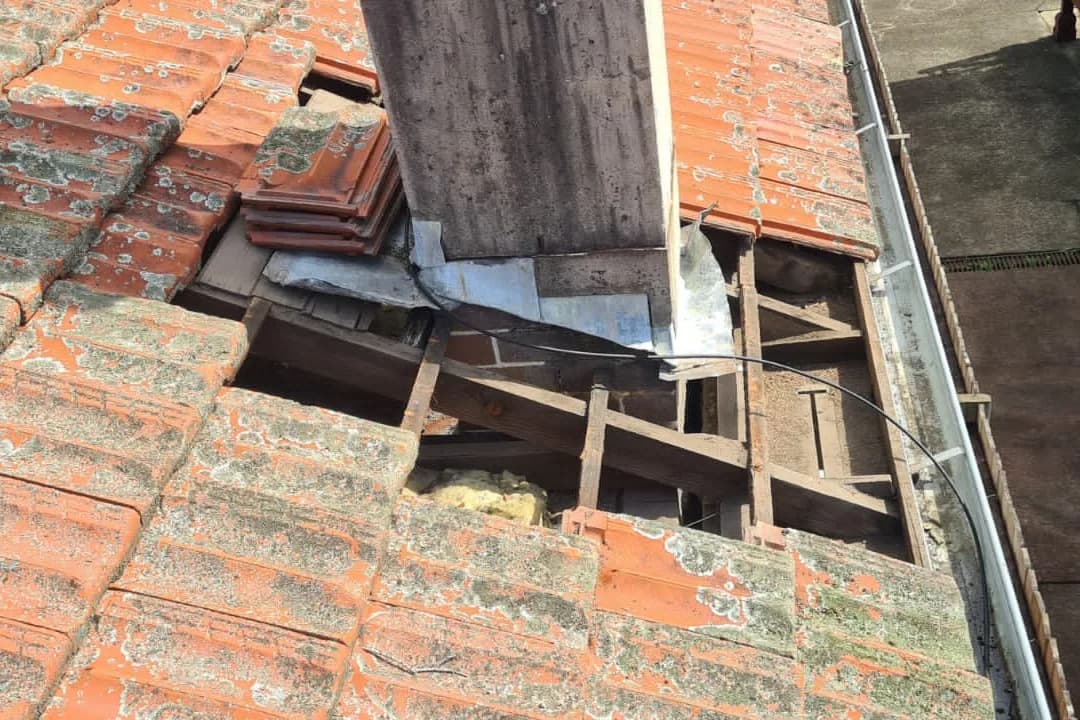
- A tarp over a hole removes the evidence along with the water. Photograph the damage first, from the ground or from a window, and photograph the inside as well.
- 3. Lodge promptly
- Most policies expect notification within a defined period. Lodging early costs nothing and preserves the option.
- 4. Get the damage described
- Not a total. A description of what has actually failed and why is what an assessor can work with.
What an assessor is deciding
The assessor is answering one question: what damage did this event cause, and what does putting it back cost.
That is a narrower question than the one a homeowner is usually asking, which is whether the roof needs replacing. The two can have different answers on the same roof.
It is why a roof with hail dents across half its area, on top of twenty five years of wear, often produces a scope for the damaged section rather than a new roof. The wear was not caused by the storm.
Where claims get argued
The disagreements are predictable and they mostly come down to separating the event from the condition.
- Age versus damage
- A roof already at the end of its life is the most common source of a partial scope. The storm did not cause the rust in the valleys.
- Matching
- Replacing a damaged section in a colour or profile that no longer matches the rest is a real problem and worth raising early rather than accepting quietly.
- Pre-existing faults
- A flashing that was wrong before the storm does not become a storm claim because it leaked during one.
- Consequential damage
- Ceilings, insulation and contents damaged by water coming through are usually separate items from the roof itself.
What a roofer should and should not do
A roofer's role in a claim is technical rather than adversarial, and the useful contribution is specific.
What helps: a clear written description of what failed, photographs of the specific damage, and a scope of works itemised enough that an assessor can price it line by line.
What does not help: arguing the claim on your behalf, or promising an outcome. Anyone guaranteeing that insurance will pay for a full replacement before the assessor has been is telling you something they cannot know.
Why Western Sydney in particular
Summer storm cells build over the ranges and track east across the plain, which puts Penrith, Blacktown, Liverpool and the Macarthur region in the path of most of them.
The pattern we see is not random. The roofs that fail in a storm are the ones that were marginal beforehand: perished washers, valleys already rusting, ridge capping that was due for repointing.
That is worth knowing in advance, because the cheapest moment to deal with an ageing roof is before the storm rather than in the queue afterwards.
After the claim is settled
If the settlement covers part of the roof and you were considering a replacement anyway, it is worth pricing both at once.
Doing the insured section and the rest as one job is nearly always cheaper than two separate visits, and it avoids the matching problem entirely.
It is also the point at which a conversion becomes worth discussing on a tile roof, because the section is coming off regardless.
If this sounds like your roof
We will come and measure it.
Ring and describe what it is doing. If it is a repair rather than a replacement, we will say so.
(02) 9072 1993