Overview
Summarise with AI
Opens the assistant with a summary prompt. Gemini does not accept a prompt in the link, so paste it there.
A metal roof rarely fails across the middle of a sheet. It fails at the cut edges, the valleys and the fixings, because that is where water sits and where the protective coating has been broken. The most reliable early warning is rust rings around the screw heads, caused by the rubber washers perishing years before the steel does. Roof life depends on the product, the coating range and distance from salt water, so the honest answer for any specific roof is the manufacturer's warranty for that product, on which correct installation is usually a condition. Most premature failures are installation failures, not product failures.
Key points
- Valleys and fixings fail first, not the sheet
- Perished screw washers turn every fixing into an open path into the roof cavity
- Coating range and distance from the coast change the expected life significantly
- Correct installation is usually a condition of the manufacturer warranty
- A recurring winter ceiling stain is an active leak, not old damage
- One leak on a sound roof is a repair, not a reason to replace the lot
Where a metal roof actually fails
The middle of a sheet is the best protected part of a metal roof. It is coated on both sides, it sheds water quickly, and nothing has been cut through it.
Everywhere else is a different story. Cut edges, valleys, ridge lines and every point where a fixing goes through the sheet are places where water lingers or the coating has been broken.
- The valleys
- Two roof planes meet and funnel every litre of water through a narrow channel. Debris collects there and stays damp, which is why valleys rust first on nearly every old roof.
- The fixings
- The rubber washer under a screw head perishes long before the steel does. Once it has gone, water tracks down the screw shank into the roof cavity, and there are hundreds of screws on a roof.
- Cut edges and penetrations
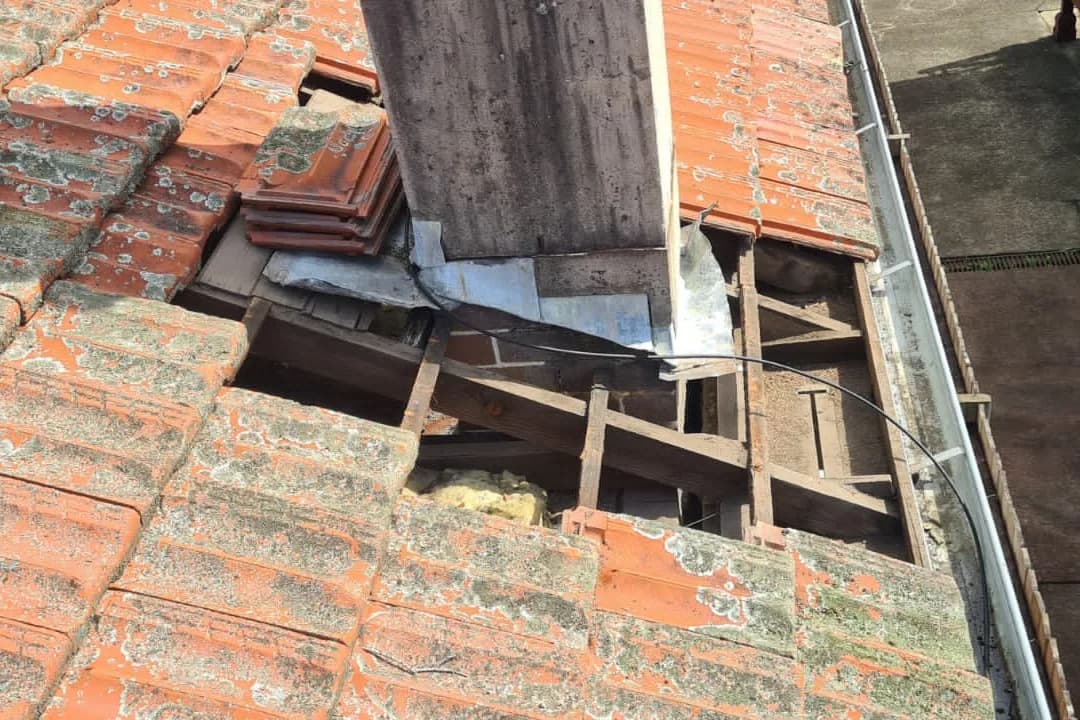
- Anywhere the sheet has been cut, the raw steel edge is exposed. Flues, vents and skylights concentrate this, which is why penetrations leak long before the roof around them does.
- Where two metals meet
- Dissimilar metals in contact with water corrode faster. A copper or lead component sitting on steel is a slow problem that shows up as a stain running down the sheet.
How to check yours without getting on the roof
Most of what you need to know is visible from a ladder at the gutter line, or from an upstairs window of a neighbouring house.
Look along the gutter line for rust at the back of the gutter and along the roof edge. Look at the valleys if you can see into them. Look at the screw heads on the closest sheet for rust rings, and look at the ridge for anything lifting.
Inside, look at the ceilings after a long wet spell. A stain that dries out and comes back each winter is an active leak, and painting over it hides the evidence rather than the water.
What shortens a roof's life
Two roofs of the same age in the same suburb can be in very different condition, and it is usually one of these reasons.
- Salt
- Steel near the coast corrodes faster, which is why there is a heavier duty coating range specified for marine environments. The standard range is not specified for very close proximity to breaking surf.
- Trees
- Overhanging branches keep the roof damp, drop debris into the valleys and hold leaf litter against the steel. It is the fastest way to age a valley.
- The wrong fixings
- There is no point putting marine-grade sheet on a roof and then screwing it down with fixings that will rust out first. Mismatched fixings are a common shortcut.
- Foot traffic
- Solar installs, antenna work and general access dent sheets and break the coating. Every dent is somewhere water now sits.
Installation is most of the answer
Steel roofing is a manufactured product with a published installation specification: fixing type, fixing spacing, minimum pitch, lap direction and flashing detail.
Nearly every premature metal roof failure is an installation failure rather than a product failure. Screws in the pan instead of the rib, laps running the wrong way relative to the prevailing weather, valleys cut too tight, and flashings sealed with silicone in place of being properly formed.
None of that is visible from the ground and none of it shows up for years. It is the main argument for caring who installs a roof rather than only what the installation costs.
Repair or replace
One leak on an otherwise sound roof is a repair. Rust in the valleys and rust rings across the fixings is a roof at the end of its life, and patching it buys a season.
The middle case is the hard one: a roof that is sound but tired, where the sheet has life left and the fixings do not. A rescrew is a real option there, and it is worth asking about rather than being sold a full replacement by default.
If this sounds like your roof
We will come and measure it.
Ring and describe what it is doing. If it is a repair rather than a replacement, we will say so.
(02) 9072 1993